
304 vs 316 Stainless Steel: What’s the Difference?
Guide
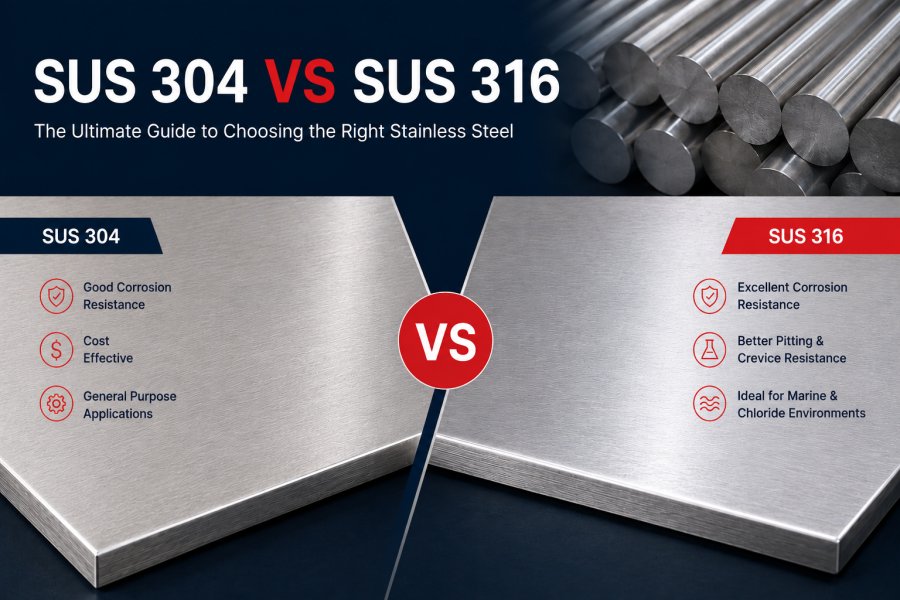
If you’re specifying Stainless Steel and unsure whether to choose 304 or 316, the short answer is: 316 costs more but resists corrosion better, especially around salt water and chemicals. Here’s the detail behind that.
Quick Answer
| SUS 304 | SUS 316 | |
|---|---|---|
| Key difference | Standard austenitic stainless | Adds molybdenum (2–3%) for extra corrosion resistance |
| Best for | General fabrication, indoor/dry use, food-grade equipment | Marine, coastal, chemical, and high-chloride environments |
| Cost | Lower | Higher, since the molybdenum content adds cost |
Composition and Why It Matters
Both are austenitic stainless steels built on a similar chromium-nickel base (roughly 18% chromium, 8–10% nickel), which is what gives Stainless Steel its corrosion resistance and non-magnetic properties in the annealed condition.
316 adds molybdenum, typically 2–3%. Molybdenum specifically improves resistance to pitting and crevice corrosion caused by chlorides: the kind of corrosion driven by salt water, de-icing salts, and many industrial chemicals. That’s the entire reason 316 exists as a separate grade: it’s 304 with a specific weakness engineered out, at a cost premium.
When to Choose 304
304 is the right default for most general fabrication, structural, and indoor applications where the steel isn’t exposed to salt water, chlorides, or aggressive chemicals. It’s the more commonly stocked, more affordable grade, and it’s more than adequate for the majority of jobs.
When to Choose 316
Choose 316 wherever chloride exposure is a real factor: marine environments, coastal construction, chemical processing, and food or pharmaceutical equipment that’s regularly exposed to saline or acidic cleaning agents. If in doubt and the part is expensive to replace or hard to access once installed, the extra cost of 316 is usually the cheaper decision long-term.
Frequently Asked Questions
Is 316 Stainless Steel always better than 304?
Not necessarily. It’s better specifically for corrosion resistance in chloride-heavy environments. For general indoor or dry-use applications, 304 performs just as well at a lower cost.
Can you tell 304 and 316 apart visually?
No, they look identical. The difference is in composition and performance, not appearance. Always confirm grade by mill certificate or supplier documentation.
Request a Quote
Tell us what you need, and we reply within one business day.